

Sub-Total: $0.00
Melbourne uni students win Rocket design comp with Slinky 3D print
12 August 2026
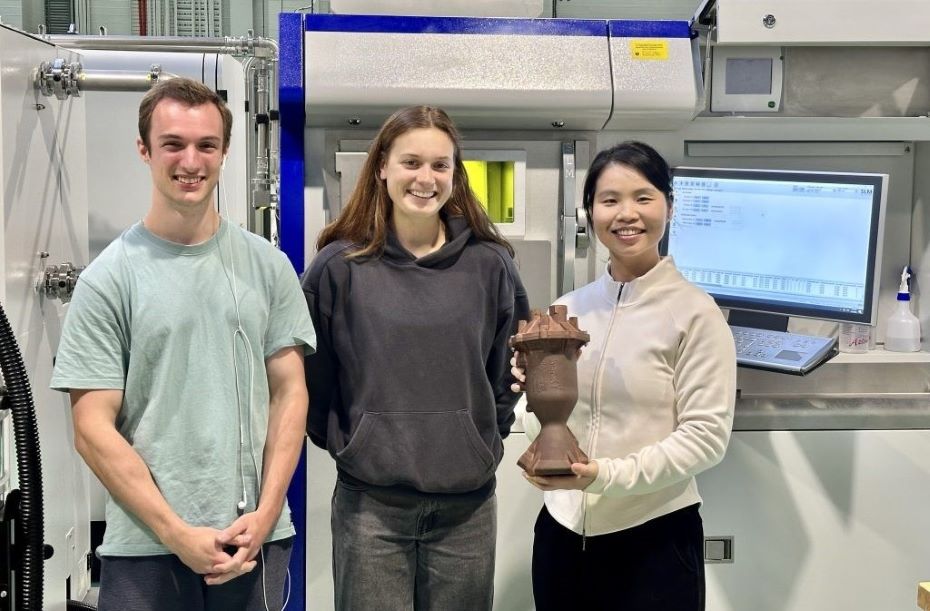
University of Melbourne students Stuart Davis and Brooke Doolan with CSIRO’s Dr Cherry Chen holding the winning rocket engine. Photo via CSIRO.
A three-person student team from the University of Melbourne has hot-fired a 3D printed, regeneratively cooled liquid bipropellant rocket engine at Race2Space in the UK, taking first place in the competition’s liquid oxygen (LOX) bipropellant category. CSIRO, which supported the build through its Lab 22 additive manufacturing centre, says it is the first regeneratively cooled liquid rocket engine an Australian student team has successfully fired at the event.
Dr. Cherry Chen, senior research scientist and team leader at CSIRO, says: “With 3D printing, we can now build channels inside the combustion chamber wall, instead of the previously complex arrangements of pipes and tubes traditionally wrapped around the chamber. Moving the coolant path inside the wall improves cooling efficiency and removes an assembly problem.”
Regenerative cooling routes one of the two liquid propellants through passages in the wall of the combustion chamber, pulling heat out of the structure before that propellant is injected and burned. It is standard practice in professional liquid propulsion but rare in student projects, because the plumbing was traditionally difficult to build – ‘tube bundles brazed one by one, jackets machined and joined, each seam a place to fail and a skill to hire for’.
The engine, nicknamed Slinky, weighs roughly 6kg and is about the size of a large pineapple. It completed five clean, stable hot fires in a single day, including throttling runs, and reached a maximum thrust of 5.4 kilonewtons, output comparable to a small lunar lander engine.
Slinky was built as an Aerospace and Rocket Engineering Society (ARES) capstone project by aerospace and mechanical engineering master’s students Jack Gardiner, Brooke Doolan, and Stuart Davis (pictured here), working with scientists and engineers at Lab 22.
Lab 22 printed the engine on a Nikon SLM Solutions 280 2MA laser powder bed fusion system at Clayton, Victoria, supported by the iLAuNCH Trailblazer Program. The material is a copper alloy, selected for thermal conductivity and its tolerance of high heat flux environments. Chen said Lab 22 advised the students on material selection, mechanical behaviour, design for additive manufacturing, and post-processing of the printed parts.
The finished hardware is a fully integrated engine with micro cooling channels embedded in the chamber wall, mounted for testing on a welded steel thrust structure built to interface with Airborne Engineering’s facilities.
Most read
- Mimaki invites dealers to see its impressive new…
- Melbourne’s Mia Saker crowned as HEXIS PWS World PPF…
- Epson sets new benchmark for high-volume business…
- Avery Dennison adds colour to premium PPF market
- Agfa appoints Brett Addison as Sales Manager –…
- Louise Paton named as 2026 FESPA Australia Future Leader