Sub-Total: $0.00
Out of the Ashes… Big Image Australia showcases new facility
27 October 2026
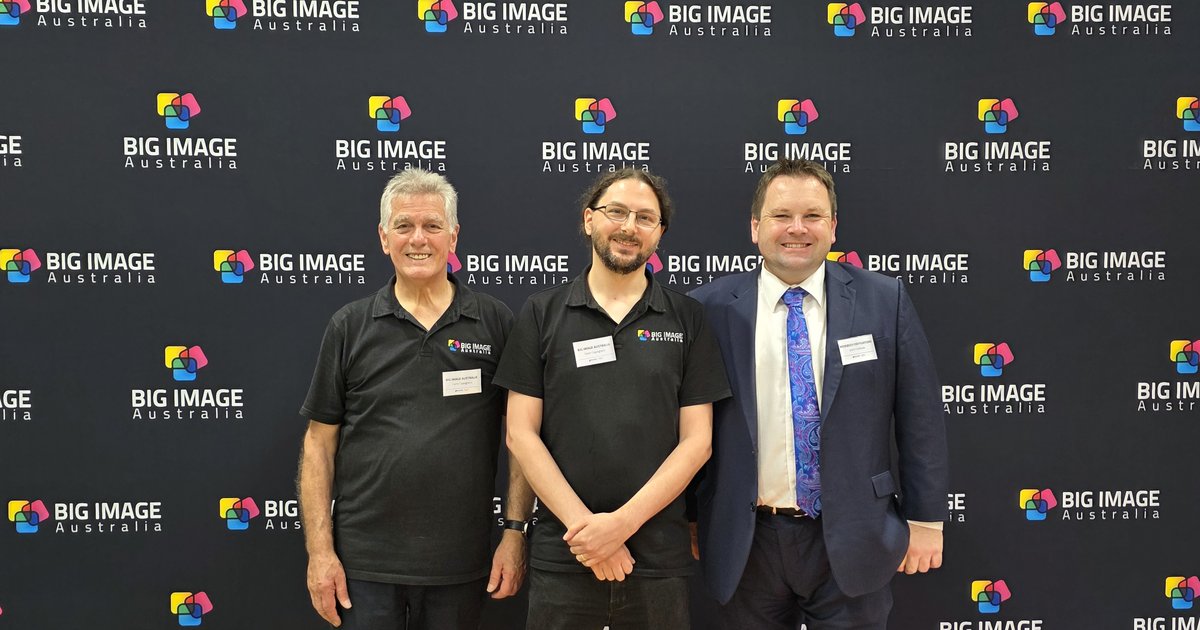
L–R: Carlo Capogreco, Deon Capogreco, John Fulbrook (Member for Playford)
Nearly six years after fire destroyed its Hindmarsh factory, Big Image Australia has shown off its rebuilt and expanded operation to more than one hundred industry guests, with owner Deon Capogreco telling the crowd the devastating setback pushed the business to come back “better, and bigger, and stronger”.
The open evening at the company’s new Greenfields premises last Thursday drew sign makers, printers, suppliers and customers from across South Australia and interstate, along with the state member for Playford, John Fulbrook, who attended on behalf of the Premier.
Big Image was operating from Hindmarsh in Adelaide when a fire that started around 9pm on Boxing Day 2020 gutted the factory. The company had moved into those larger premises only 18 months earlier and was on a growth run, with a new Gerber/MTC table cutter installed in 2019. Its fleet at the time included a recently added HP R2000 Latex flatbed, HP Latex roll-to-roll printing, a Fujifilm 5 metre roll-to-roll machine and the large Gerber cutter. Capogreco said the business had grown to about 10 staff by 2019.
“We put a lot of work into that building,” he said. “Then on Boxing Day 2020 a fire burnt down our place. It destroyed everything.” Pausing with emotion as he spoke, Capogreco said the experience taught him how willing people in the industry are to help.
“We were so grateful that many companies, many people, many suppliers and many customers came to our support. Many of you are in the room tonight, and I want to thank you personally. It gave us the impetus not to just come back as we were, but to become better, and bigger, and stronger.”
“It took nine months to find a site and fit out the new factory. The 1500 square metre building was meant to be enough. It wasn’t. We thought we’d come here, 1500 square metres, that’s it, perfect space for us,” Capogreco said. “Within three years we didn’t have the elbow room anymore.”
Big Image Australia has since added a second 1100sqm warehouse, brought in dye sublimation fabric printing for products such as media walls, and doubled down on digital cutting with a 20m long cutting and edging line enabling all cutting to be done in house. It has also invested significantly in automation, including online ordering and automatic file preparation.
“It’s an ongoing process. I’m sure some of you are looking at those things now yourselves,” he said.
New product lines on display included honeycomb board structures and display stands made from recycled materials. The company is also printing gazebos, umbrellas, outdoor flag products and extrusion-based structures.
Growing up in the trade
Capogreco’s path into the industry started in the 1990s, when his father, Carlo, opened a Best Instant Signs franchise.
“Rather than after-school care, I would go into Best Instant Signs and do my homework on their computers,” he said. “I ended up weeding vinyl, applying vinyl to panels, learning how to use a plotter. But mostly I swept the floor.”
He joined Big Image Australia in the early 2010s, when it had three people and two digital printers. His father wanted to replace old technology, take some risks and do bigger work, which is where the name came from.
The reason for the business existing, he said, was to produce locally rather than wait on interstate suppliers.
“Coming from the sign industry, we used to get a lot of our work from interstate. The idea always was that we can produce it here in South Australia and supply everyone as it’s needed. No waiting on travel time or problems in shipping. Make it locally, hire local people and supply the local market.”
Big Image offers trade printing to the signage industry many of whom were in attendance on the night. “We want to be people you can come and talk to when you have issues, or when you have an idea and you don’t quite know how to do it,” he said. “The kinds of work you do determine the kinds of investments we make. We want to provide the things that will make your work faster and cheaper and allow you to compete with interstate companies, concluded Capogreco.”