

Sub-Total: $0.00
Developing a new 3D printing technique
23 July 2026
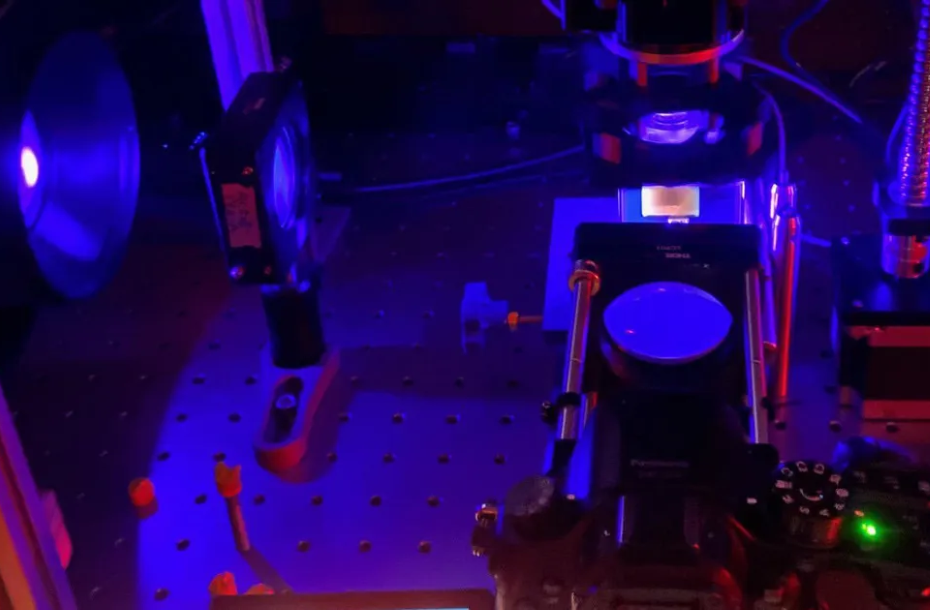
VAM uses patterns of light to simultaneously produce an entire structure inside a liquid resin. Image: University of Nottingham
Academics at the University of Nottingham’s Faculty of Engineering, in collaboration with the University of California, Berkeley, have developed an enhancement for a type of 3D printing called Volumetric Additive Manufacturing (VAM), which can create whole objects in seconds to minutes. This is essentially a new 3D printing technique that allows the printing of whole objects and controls the temperature of the chemical reaction to stabilise the process.
Eduards Krumins, a research fellow from the Additive Manufacturing Research Group, says: “In this work we have introduced a new chemistry approach to VAM called Reversible Addition Fragmentation chain Transfer (RAFT) polymerisation to solve the problem with heat.
“In simple terms, it acts like a built-in ‘regulator’ for the reaction, both slowing and regulating how the material is formed. This prevents sudden heat spikes and keeps the printing process stable and predictable.”
Instead of building an object layer by layer like traditional 3D printing, VAM uses patterns of light to simultaneously produce an entire structure inside a liquid resin. This is said to allow extremely fast printing and the ability to create complex shapes that would be difficult to produce using conventional methods. Researchers said it also avoids the delamination that can occur between the layers of standard 3D printing techniques, because it avoids sequential layer deposition.
This process has always been limited by the heat produced by the chemical reaction the process relies on, where temperatures can rise by more than 60°C. This heat can cause the reaction to run out of control, leading to distortions and loss of detail, while also limiting how large printed objects can be.
But these latest research results show a clear reduction in temperature build-up during printing, along with fewer thermal instabilities which can distort printed structures. The team has demonstrated the ability to print multiple parts at the same time with gaps as small as about 150 micrometres: ‘a significant improvement compared to normal’ VAM, which can therefore greatly improve the efficiency of the technology when used correctly’.
The RAFT chemistry also allows printed objects to retain reactive sites that can be used afterwards to modify or enhance the material. This opens the door to adding new functions after printing, such as anti-fouling and anti-bacterial coatings.
Derek Irvine, professor of Materials Chemistry in the Department of Chemical and Environmental Engineering, adds: “This research represents a step change in volumetric 3D printing: making it more stable and more versatile, unlocking designs and functions that were previously out of reach. Looking ahead it has the potential to be used in a range of applications and an area it could be especially important for is medical applications such as future bioprinting technologies. We are now exploring how to scale the process for larger and more practical industrial real-world use.”
This new research has been published in peer-reviewed, open access, scientific journal Nature Communications.




Most read
- Mimaki invites dealers to see its impressive new…
- Melbourne’s Mia Saker crowned as HEXIS PWS World PPF…
- Epson sets new benchmark for high-volume business…
- Avery Dennison adds colour to premium PPF market
- Agfa appoints Brett Addison as Sales Manager –…
- Louise Paton named as 2026 FESPA Australia Future Leader