Sub-Total: $0.00
BIOND Bio-print film supports FESPA Foundation’s South African school project
8 June 2026
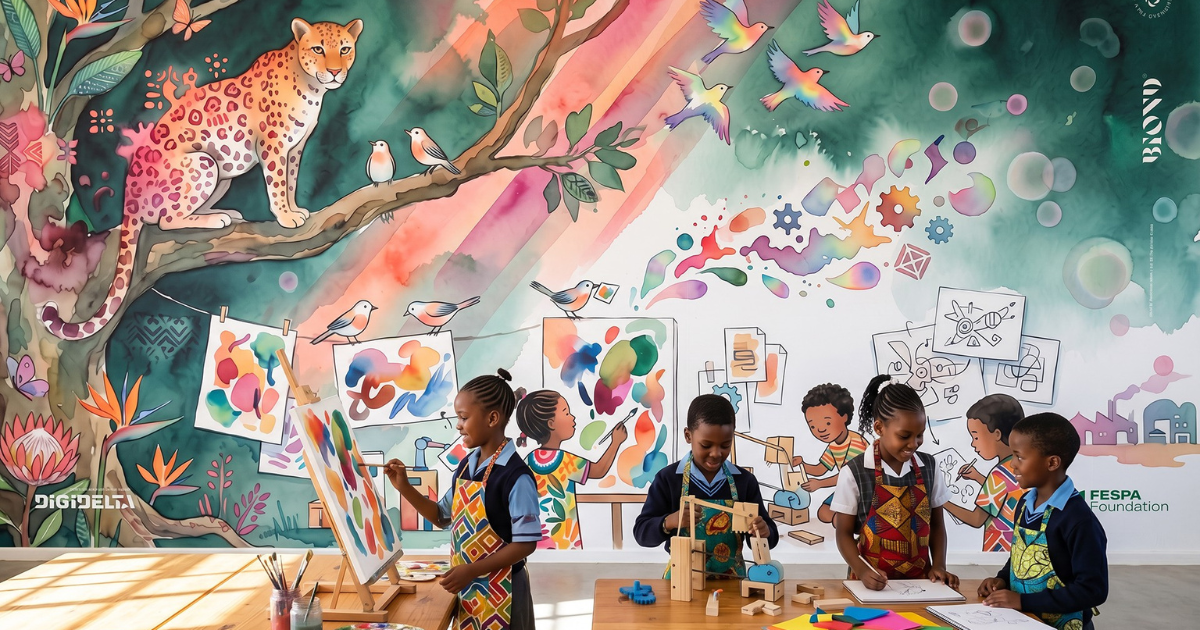
Digidelta recently used its BIOND Bio-Print Film P HT BF 90 White Matte film to produce a set of wall graphics for classrooms at a primary school in South Africa.
The ‘Roots of Tomorrow’ project came about through the FESPA Foundation 2026, with Digidelta as an official partner of the initiative. Each year, the FESPA Foundation mobilises international printing industry partners to contribute products, materials, and services in the months leading up to the FESPA Global Print Expo, which this year took place from 19-22 May in Barcelona, Spain, in a sustainable manner.
For its 2026 edition, the initiative adopted the theme of the ‘Big Animal School’, centred on a collective effort to rebuild classrooms in South African primary schools. Digidelta’s role was to both design and produce educational wall graphics for the Batau Primary School, which was undergoing renovation.
Due to the classroom setting where the graphics would be installed, this posed an additional challenge for Digidelta. Strict rules and regulations meant it was limited to using only materials and consumables that ensured the printed applications would be suitable and safe in this environment.
After evaluating the project and how to deliver the best possible quality, the company’s expert team at its Torres Novas site in Portugal settled on BIOND Bio-Print Film P HT BF 90 White Matte.
Part of Digidelta’s BIOND range of bio-based printable films, the product is free from plasticisers, has a 90-micron thickness, a permanent high-tack adhesive, and a bubble-free liner. Together, these features ensure high stability during printing and place the product as an ideal solution for a wide range of promotional applications, including interior wall graphics. In addition, the film carries an EN 13501-1:2018 reaction-to-fire classification, demonstrating its safety for use across various indoor environments.
However, material was only part of the equation; Digidelta was also tasked with using hardware to deliver high-quality output. As a Mimaki distributor in the Iberia region for almost 25 years, Digidelta opted for the Mimaki UCJV330 print and cut UV LED inkjet printer, the flagship UV model from Mimaki that can print on media up to 1mm thick and as wide as 1.6m with the 130 model or 1.6m on the 160 machine. Other features include a maximum cutting speed of 300 mm/s and a range of colour options across various ink sets.
In terms of inks, to meet the strict criteria for printed applications in classrooms, Digidelta chose to run Mimaki LUS170 inks. These carry the key UL Greenguard Gold certification, regarded as one of the most demanding standards for low emission of volatile organic compounds (VOCs) in sensitive environments, including spaces where children are present.
After the graphics were produced in-house by the expert team at Digidelta, they were shipped to the 2026 FESPA Global Print Expo and will be sent on to the school in South Africa, ready for installation in classrooms later this year.
Each Batau classroom is dedicated to one ‘Big 5’ animal and a specific educational focus. The Lion Classroom focuses on leadership and confidence; the Elephant Classroom, wisdom and strength; the Leopard Classroom, agility and creativity; the Rhino Classroom, strength and authority; and the Buffalo Classroom, teamwork and resilience.
“We wanted each classroom to feel educational and inspiring, rather than simply decorative,” said Fábio Costa, Marketing Manager at Digidelta. “Each animal theme represents different qualities such as teamwork, creativity and leadership, helping create an engaging environment for students.”
Armando Mota, CEO of Digidelta, added: “At Digidelta, we have always believed that the purpose of what we manufacture goes beyond its technical performance. We created BIOND because we believe it is possible to make materials that are better for the environment and for the people who live alongside them.
“When the FESPA Foundation came to us with this project, it felt like a direct expression of that belief. A bio-based film, in a school, on walls that children will look at every day for years. That is the world we are trying to help build.”